
How to Save Ideas for Generations to Come

“The Lord answered me: ‘Write down what I show you. Write it clearly on stone tablets so whoever reads it can run to tell others.’” — Habakkuk 2:2 (ICB)
Some things aren’t just for now.
God told the prophet Habakkuk to write down the vision—not because Habakkuk might forget it, but because others needed to run with it. Generations needed to hear it. Lives depended on it.
That’s still true today. The thoughts, insights, and revelations we’re given—big or small—aren’t just for our own encouragement. Many of them are meant to be written down, made clear, and passed on.

Let’s break this down phrase by phrase.
1. “Write down what I show you”
God has always partnered with the written word. Throughout Scripture, we see this recurring instruction:
“Get a scroll and write down everything I’ve told you…” — Jeremiah 36:2
“He shall write for himself in a book a copy of this law... and read it all the days of his life.” — Deuteronomy 17:18-20
“Write: for these words are true and faithful.” — Revelation 21:5
Why? Because memory fades. Culture shifts. People forget. But written words endure.
We don’t always realize it, but we’re being shown things constantly—if we’re paying attention.
What do I mean by "what we're shown"?
Maybe while reading Scripture, you feel a quiet nudge about a long-held dream.
Maybe it’s a one-liner from a podcast that won’t leave your mind.
Or a line from a book that strikes a deep chord—harmonizing with something already playing in your heart.
Or a thought while walking, so subtle you almost missed it… but if acted on, it could change your life.
“The world is full of magic things, patiently waiting for our senses to grow sharper.” — W.B. Yeats
Ideas like these aren’t accidents. They’re invitations. Write them down.
2. “Write it clearly”
This isn’t just about writing it down; it’s about how we write it.
God didn’t say “scribble it somewhere.” He said “write it clearly.”
Clarity makes ideas:
Understandable
Sharable
Repeatable
Actionable
Some of the clearest, simplest phrases have changed lives:
“Amazing grace, how sweet the sound…”
“Love your neighbor as yourself.”
“I have a dream.”
If you want your insights to outlive you, write like someone else’s life depends on understanding what you mean. Because one day, it might.

3. “On stone tablets”
This speaks to where and how long your words should live.
Back then, stone tablets were:
Durable
Widely available
Portable
Today’s “stone tablets” might be:
A journal
A Substack post
A book
A digital garden
A voice note
A website
What matters is that you put the idea somewhere it can be preserved. Somewhere it can be found again—not just by you, but by the people who need it most.
Don’t bury gold in your Notes app. Publish it. Share it. Archive it somewhere retrievable.
4. “So whoever reads it can run to tell others”
This is the purpose.
The point of writing down what you’re shown isn’t just documentation—it’s multiplication.
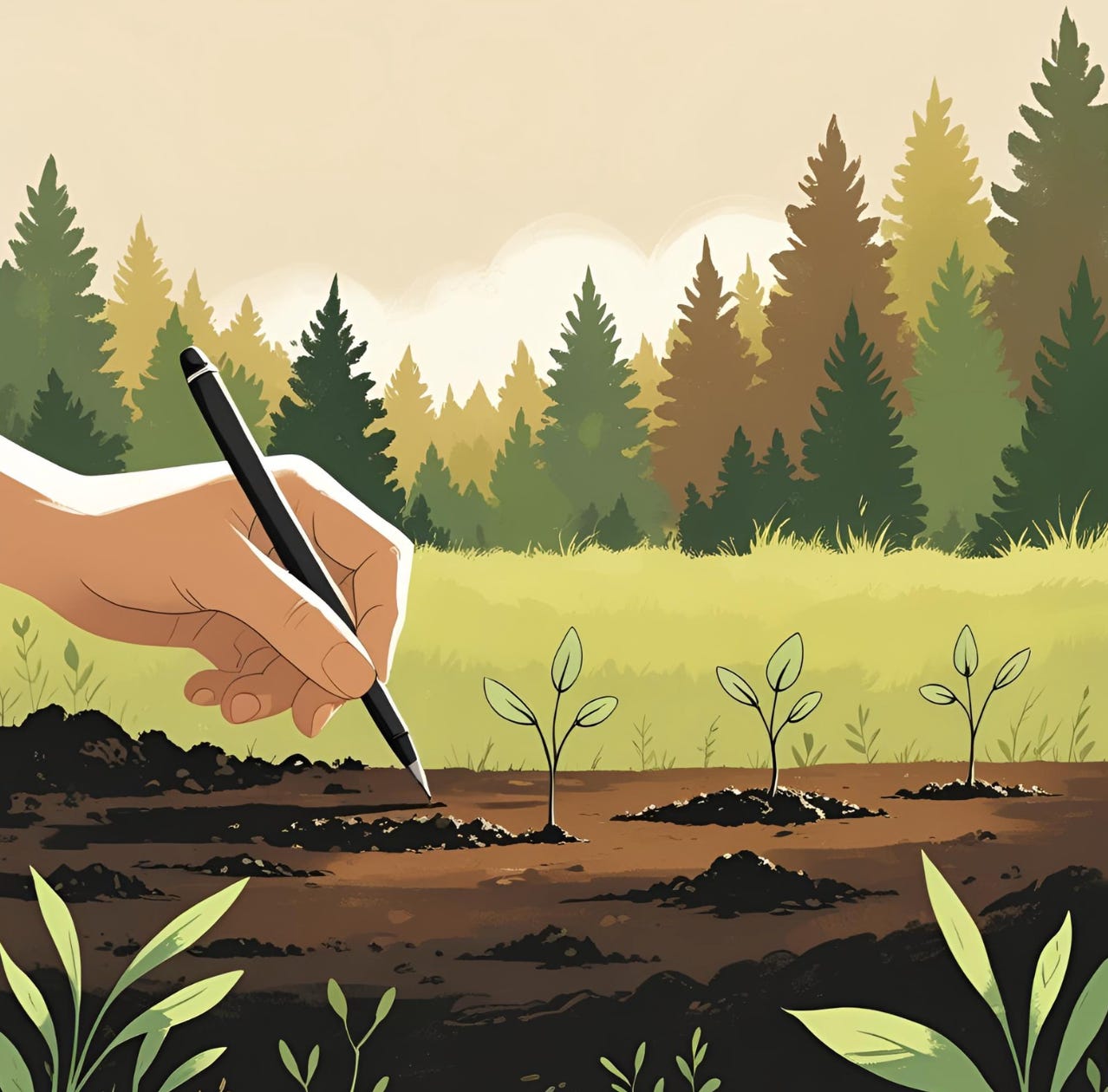
You never know who is searching for the exact perspective you’ve been given.
They might be stuck in a life raft, floating aimlessly, and the thing you wrote—the sentence you almost deleted—might be the paddle that moves them forward.
And once they find it? They run. They share. Not necessarily because of you, but because of the clarity and hope your words sparked in them.
When revelation is made clear, it creates momentum.
Some of your ideas are just for you. But many are meant for others too.
So capture them.
Clarify them.
Carve them into stone—figuratively or literally.
And trust that when the right people read them, they’ll run.
Because what you’re shown today might be what someone else is waiting for tomorrow.
If this post spoke to you, here’s how you can support my work:
Pick up one of my eBooks if you’d like to explore these ideas more deeply (or gift to a friend!):
Forward this post to a fellow deep thinker who might appreciate it too.
Hit reply and tell me what stood out to you, share an idea it sparked, or just say hello.