How to Think With Your Commonplace Book (Not Just Fill It)
Collecting ideas is easy. Here's the practice that turns them into revelations — plus 3 ways to stoke a thinking session.

This week I started a thinking session in Ember around a single question: how do I think with my commonplace book? This article is what came out of it.
Last time, I wrote about keeping a commonplace book — Emerson’s charge to “make your own Bible,” gathering the words that have pierced you. I said that a good commonplace book is like a museum, not a warehouse: curated, not crammed. That’s still true. But here’s the thing about museums — you’ll never experience the art by owning the building. You have to visit. You have to stand in front of the paintings and look.
And then you realize something more: you don’t have to just look. You can interact with them. Think about them. Reflect on them. Talk back to them, even.
That’s the other half of the work. Keeping is only the beginning. The real return comes from engaging with your commonplace book — something closer to a conversation than a filing system.
Here’s how that works, in two levels.
Level one: Review
The first step is simple. Spend twenty minutes with your commonplace book. Just look. Read back through the ideas you’ve captured and let them work on you again.
That alone is powerful. You’re re-exposing yourself to brilliant ideas — things that resonated with you enough to write down in the first place. You rethink parts of your life. You refocus on things you’d forgotten. Your commonplace book starts to function like a compass.
And notice what this experience does to you compared to its obvious competitor for your attention. Scroll social media for twenty minutes and you often leave comparing yourself to others, a little drained. Spend twenty minutes with the quotes and ideas that once moved you, and you leave challenged and filled with joy. Strengthened, not weakened.
Level two: Think
But there’s a deeper level. Not just reading the ideas — writing your thoughts in response to them.
The moment you start having a journal-like experience with the ideas in your commonplace book, something changes. You’re spending more time with the idea. You’re engaging at a deeper level. The relationship strengthens, and something forms in you. You gain revelations — and a new relationship with an idea can motivate you in ways that merely looking at it never will.
This is actually why I built Ember: not as a place to store ideas, but as a place to think with them. To engage with the quote that moved you last week and the idea that came to mind yesterday. Even the vocabulary matters — in Ember you don’t create documents or notes, you start a thinking session. The naming shapes the experience.
But you don’t need Ember to do this. Here’s the practice.
The practice
First, set aside time. You can’t expect a rhythm you never scheduled. For me, it’s my morning walk. The walk came first — an existing habit — and I stacked thinking onto it. Attaching a new habit to an established one makes it far easier to keep. Pick your time and place before you pick your idea.
Then, pick one idea. Just one. It doesn’t have to relate to your projects or your plans for the day. Pick the one arrow that pierces you in a good way — the idea that excites you — and write about it. What does it stir in you? What do you immediately think of? What would happen if you actually applied it?
Write your first thoughts down. And when you feel like you’re done — you’re not. That’s when you stoke the fire.
Three ways to stoke a thinking session

1. Stoke it with a related idea. Go back through your commonplace book and hunt for something connected — another angle, another perspective. In Ember, the related idea feature does this search for you; an idea you saved a year ago might surface in the session you started today. Either way, it’s like turning over a rock. You suddenly see another side.
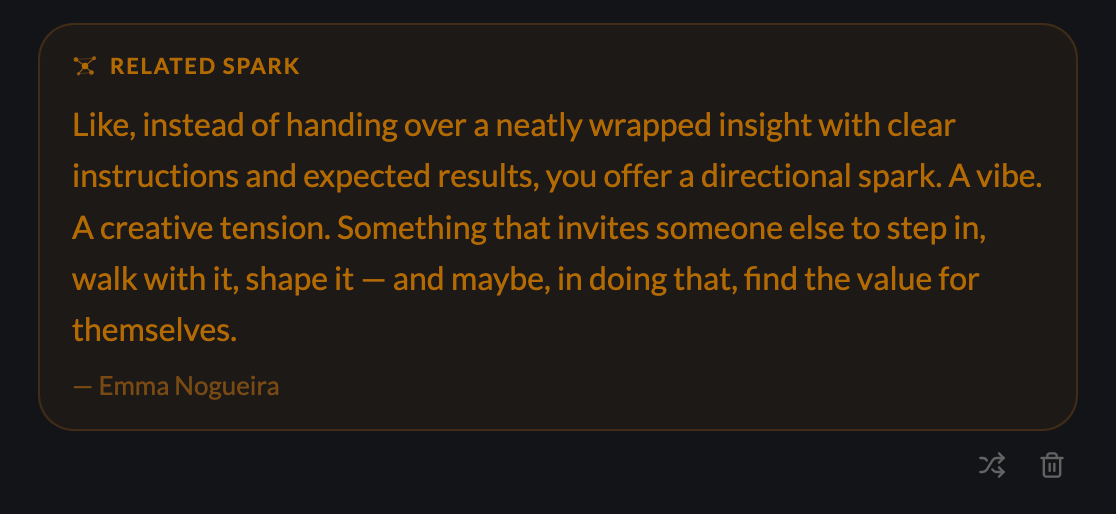
2. Stoke it with a question. Ask yourself a question about what you’ve written. Questions are powerful precisely because they don’t hand you an answer — they hand you a door.
Two practical ways to do this:
Borrow a question-asker. Take a screenshot of your current thinking and drop it into Claude or ChatGPT with a simple prompt: “Ask me one question at a time to help me keep writing about this idea.” One question at a time is the key — you want a door, not a hallway of doors.
Use the Five Whys. Toyota built this into their factory floors, and it works just as well on the soul. Write something down, then ask: Why does this matter to me? Write the answer. Then ask it again of what you just wrote. By the third or fourth why, you’re usually past the surface and into the real thing.
In Ember, the question feature does this for you — it reads the whole thinking session and asks something designed to dig deeper and unlock a new perspective.

3. Stoke it with your past sessions. This is where it gets really interesting. Over time, as you think about ideas one at a time, you build up a record of thinking sessions — and patterns of your own thought begin to emerge. You start to see not just what other people have said, but what you’ve been saying, session after session.
For this to work, you have to document your sessions somewhere. A notebook works. So does a digital home like Notion, Obsidian, or Bear. The tool matters less than the habit: each thinking session gets written down and kept.
Then, when you’re in a session and the first flame dies down, go back through your past sessions and look for the ones that connect. As you review, you’ll start noticing what keeps coming up. Maybe it’s a word. Maybe it’s a phrase, or a feeling. Maybe it’s a desire that keeps showing up, or a problem you keep circling back to. The quotes you’ve saved in your commonplace book are surfacing something in you — but you only see it when you review your sessions in the practice of writing.
When you find a related session, make the connection permanent. If you use Obsidian, link the two sessions together. If you use a notebook, jot down a note pointing back to it — “see also: March 12, on attention.” Suddenly you don’t just have sessions. You have interconnected sessions — a map of your own mind forming over time.
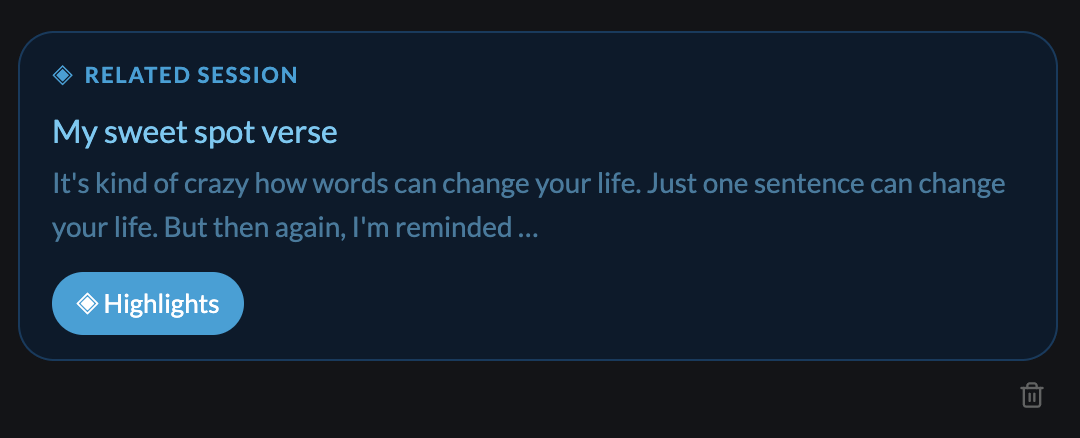
In Ember, this happens automatically. It surfaces related sessions by title and pulls out the highlights — specific words you wrote that connect to what you’re thinking now — to get something stirred in you.
None of this requires an app. It requires a rhythm, one idea at a time, and the willingness to keep stoking when the first flame dies down. The tool just lowers the friction.
You’ve built the museum. Now visit it — and don’t just admire the paintings. Sit with them. Question them. Let them question you.
And if you'd like a place built specifically for this — where your saved ideas, thinking sessions, questions, and patterns all live together and stoke each other — that's exactly what I made Ember for. Start a thinking session with one idea from your commonplace book and see what it stirs. The first fire is the hardest to light. After that, you'll want to keep tending it.
WoW! Greg! This article alone qualifies you to hold the title "The Idea Shepherd." The guiding of thoughts is so much more detailed than just "thinking." Thanks for the shepherding!
Making this a habit really helps develop creativity and more original thinking. We rarely take the time to just sit with our own thoughts and see what we can come up with. Making this a habitual practice is incredibly valuable.