
Before You Build Another Second Brain, Read This About Sam Altman
Still searching for the “perfect” note-taking system? These 9 lessons might change how you think forever.

A Small Favor Before We Begin
I love showing up here with fresh sparks for your thought life. These notes take time, thinking, and a lot of sunrise scribbles — and I’m grateful you’re reading.
If you’d like to help keep the lantern glowing, you can:
📚 Buy me a book (instead of a coffee haha) — a one-time gift or a steady pledge that fuels new idea work.
💡 Grab one of my e-books — guides for stewarding your own ideas well (especially in the age of AI).
✉️ Pass this along — forward to a friend who might need it.
👋 Hit reply — tell me what stood out, or just say hi.
Even a quick hello reminds me this work is worth doing. Thanks for walking this path with me. ❤️
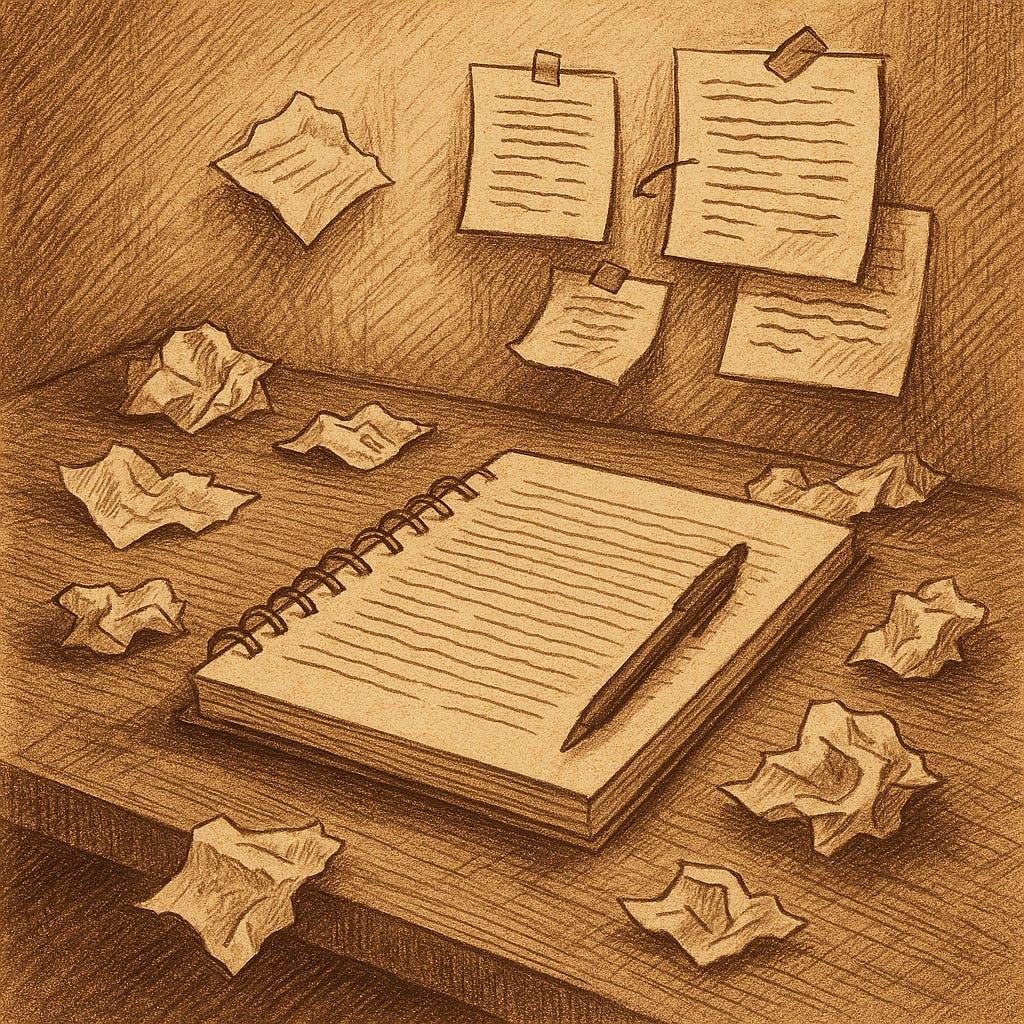
I recently listened to David Perell’s conversation with Sam Altman (CEO of OpenAI) about his note-taking process.
I went in curious about tools; I came out with lessons about how to think.
Here’s what stood out — and what I’m carrying into my own practice as an Idea Shepherd.
1. Systems Are Discovered, Not Pre-Installed
Sam didn’t wake up with the perfect setup. He tinkered until he found a spiral notebook that rips cleanly, has a hard front/back to lay flat, and the exact pen he likes.
Takeaway: Don’t over-romanticize someone else’s system. Try things. If a tool doesn’t help you think, pivot quickly and move on.
Shepherd’s Pause:
What setup are you enduring just because it’s trendy? Could you try a small pivot this week?
2. Give Your Ideas Space to Spread
Sam rips pages out so he can lay them on the table and look at many at once. It’s about seeing connections.
That’s why I love visual whiteboards — they let me scatter thoughts and watch trails form.
Shepherd’s Pause:
When’s the last time you physically spread your ideas out to look for patterns?
3. Capture → Harvest → Carry Forward
He writes freely, then harvests the good ideas and lets the rest go. A 100-page notebook might shrink to 25 pages.
It’s very Zettelkasten-ish: let thoughts serve their moment, then keep only what earns a future.
Shepherd’s Pause:
Are you building a museum of every note, or a workshop that keeps only the tools you use?
4. Always Have a Net for Ideas
One non-negotiable: the notebook fits in his pocket. Ideas don’t wait for Wi-Fi.
I mostly capture in Sublime, but I keep a tiny field notebook tucked in my wallet pouch. It’s my offline safety net.
Shepherd’s Pause:
Do you have an always-with-you capture tool for unexpected sparks?
5. Stop Sinking — Stay with What Works
Sam’s system came from trial and error, not chasing every new app.
I think of Peter walking on water — he stayed afloat while focused, but sank when he looked at the waves. We do the same: we stop capturing and start YouTubing “perfect workflows.”
Shepherd’s Pause:
Is your current method “good enough to keep you thinking”? Stick with it instead of chasing every new feature.
6. Writing Is Thinking
Sam: “For me, writing is a tool for thinking.”
Same here. If you want deeper thoughts, don’t wait — write. Even messy, even voice-to-text. The act forces clarity and sparks connections.
Shepherd’s Pause:
Want richer thinking? Use the oldest tool we have — write more.
7. Protect Time — Even 11 Minutes
Sam’s ideal: coffee shop, headphones, long stretch of quiet. Reality: I’ll take any 11 minutes of peace I can get.
I have an early-morning walk where I talk and record. It’s where 90–95% of my insights appear. Yours might look different, but make some appointment with your own mind.
Shepherd’s Pause:
Where could you carve out a small but sacred space to think this week?
8. Know Your Generative Mode
David Perell is most creative by talking; Sam is most creative by writing.
I’ve learned I’m like David: walking and talking keeps my inner editor quiet and lets ideas tumble out.
Once you know where your ideas flow — mouth, keyboard, pen — double down.
Shepherd’s Pause:
Do your best thoughts surface out loud or on the page? How can you give that mode more room?
9. Balance Solitude and Conversation
Sam values both: solo time to think, conversations to refine.
I lean toward solitude, but I’m learning that other perspectives sharpen mine.
Shepherd’s Pause:
Do you need more solitude for clarity — or more conversation to stretch your thinking?
The Bigger Picture
None of this is about the perfect notebook. It’s about building a rich thought life — experimenting, pruning, protecting time, and knowing how you personally generate insight.
Start with what you have. Stay focused long enough to think deeply. Adjust as you go. And when the next shiny app shows up… maybe stay in the boat.
There's a lot of value in this, there are hundreds of "proven" systems out there, none will be a perfect fit for you. You need to take what works, iterate and craft your own system in line with you goals, values and work styles. Otherwise you'll just get lost in the noise.